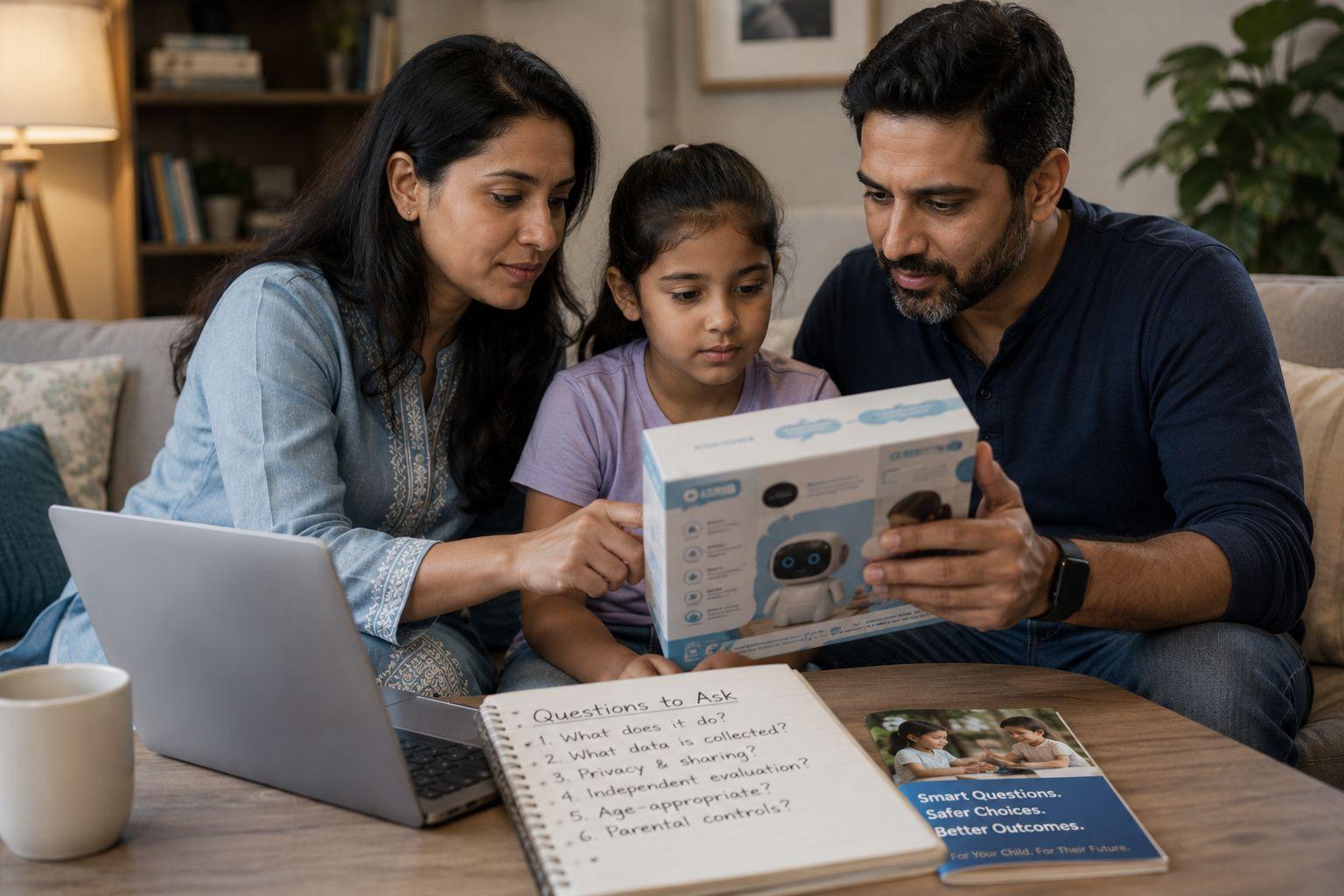
Most AI products marketed to children are not independently evaluated. Most marketing claims about safety are based on internal testing and design intent, not on demonstrated outcomes. Families making decisions about AI products for their children are largely on their own, beyond what the developer chooses to share, the regulator chooses to require, and what independent reviewers choose to evaluate.
This article is a practical, plain-language checklist for families considering an AI product for their child. It is not a buying guide and does not endorse any specific product. It is a set of questions to ask, of the product, of the developer, and of yourself as a family, before bringing AI into your child's life.
Questions to ask before buying
1. What does this product actually do?
Marketing claims are not specifications. 'Helps your child learn' could mean many things, most of which are not equivalent in effect. Specific descriptions of what the AI does, what it does not do, what age range it is designed for, and what claims of effectiveness are based on are reasonable to ask for. Developers who can't or won't provide them are giving you information.
2. What data does it collect?
Voice recordings. Video. Chat content. Behavioral patterns. Location. Device information. Inferred psychological state. The list of what AI products can collect is long. Specific, plain-language answers about what is collected, for what purpose, how long it's retained, and what is done with it are reasonable to expect. Privacy policies that require a lawyer to interpret are themselves a signal.
3. Does the developer share data with third parties?
Third-party data sharing is one of the highest-risk practices in children's products and one of the most opaquely disclosed. Specific, named third parties, not 'service providers and partners', are what good practice looks like. Broad sharing rights are common but rarely necessary for the product's actual function.
4. What independent evaluation has been done?
Internal testing by the developer's own team is necessary but not sufficient. Look for independent third-party evaluation, by academic researchers, by safety-focused organizations, by recognized child-development experts. Absence of independent evaluation is information. Marketing language like 'tested by experts' without specifics is not the same thing.
5. What happens when the AI gets it wrong?
AI gets things wrong. Generative AI gets things wrong frequently. The question is what happens when it does: does it acknowledge uncertainty, does it allow correction, is the family informed, can the child develop appropriate skepticism rather than treating the AI as infallible. Products that present AI output as authoritative without acknowledging uncertainty are different from products that model honest engagement with AI's limits.
6. What kind of engagement is the product designed for?
Some products are designed for short, purposeful interactions. Others are designed for extended attachment. Understanding which kind of engagement the product is optimized for, and whether that engagement is appropriate for your child, is one of the most important evaluation dimensions, and one that is rarely discussed openly in marketing.
7. What controls do families actually have?
Parental controls vary widely. The useful question is: can you actually see what the AI does with your child, can you set meaningful limits, can you change settings without the child being able to easily override them, can you delete data and have it actually be deleted. Theoretical controls behind a complex settings menu are different from controls families can actually use.
8. What does the developer's incident history look like?
Has this product been associated with reported safety incidents? How did the developer respond, quickly and constructively, or defensively? Has the underlying model been updated since launch, and how were safety properties affected? Track record matters more than promises.
9. Is this AI replacing something the child needs from a human?
AI companionship is not human companionship. AI tutoring is not human teaching. AI listening is not the listening of someone who genuinely cares. AI can complement what humans provide. Sometimes it can substitute well enough. Sometimes it shouldn't substitute at all. The question of what the AI is replacing in the child's life is worth asking before bringing the AI in.
10. What does your child actually need?
The most important question is the one that has nothing to do with the product. What does your child actually need, for learning, for connection, for development, for entertainment, for support? Some children's needs are well-served by specific AI products. Some children's needs are not. Starting from the child's actual needs and asking which products genuinely serve them is different from starting from a product and asking how it might fit.
After bringing the product home
The evaluation does not end at purchase. After bringing an AI product into the home, useful questions include:
● Does the child engage with the product in ways that are healthy, or in ways that suggest dependence or distress?
● Are the child's relationships with humans growing or shrinking as the AI becomes part of their life?
● Does the child understand what the AI is and is not, that it is not a person, does not know them, does not have their interests at heart in the way humans do?
● Does the AI's behavior seem to be changing over time? Generative AI products are subject to model updates that can shift behavior
● Does the product still feel age-appropriate as the child grows? Products appropriate at 5 are often not appropriate at 8; products appropriate at 8 are often not appropriate at 12
● Does anything about how the child uses the product worry you, for any reason? Parental intuition is information, even when you can't articulate the specific concern
When to walk away
Some AI products will not pass the questions above no matter how compelling their marketing. When that happens, walking away is a legitimate and important decision. Specifically:
● Marketing claims that exceed what the developer can substantiate with specific evidence
● Privacy practices the developer cannot or will not explain in plain language
● Engagement design clearly oriented around maximum usage, not child wellbeing
● No independent evaluation, with the developer's only safety claim being internal testing
● Defensive or evasive responses to reasonable questions
● Track record of incidents with poor or absent response
● Patterns of behavior that have changed your child for the worse since the product entered their life
● Any gut sense that something is off, even when you can't fully articulate it
Where to find more help
The Mobiloitte Foundation's annual AI Toys and Apps Safety Index covers many of the products most families are considering. The Index is freely accessible, methodology is published, and updates are published as products and models change. Other independent organizations, 5Rights Foundation, Common Sense Media, the Internet Safety Coalition, academic researchers, also produce evaluations and resources that complement what the Foundation publishes.
Where a product matters enough to you that an hour of evaluation is worth it, do that hour. The cost of bringing the wrong AI product into a child's life is much higher than the cost of choosing carefully.
The shift to make
Stop trusting the marketing.
Start trusting the evidence: what the product actually does, what the data shows, what independent reviewers find, what your own observation tells you about how the AI is affecting your child.
Families who buy AI products for their children with this kind of evaluation discipline get better outcomes than families who buy based on marketing claims. They also send a signal to the market, that families care about substance, not slogans, that, over time, shapes what developers build. The cumulative effect of millions of families asking better questions is a better field for children.